


Looking for care usually doesn’t start with a plan – it starts with a need. It may be due to a disability, ageing parents requiring help at home, or navigating NDIS support for the first time. In these moments, people are often seeking clarity, not complex explanations. Yet confusion often arises early in the process. Disability support, in-home care, and personal care are commonly described in similar ways, even though each service is designed for very different support needs. Choosing the wrong option can result in gaps in care, funding complications, or support that doesn’t fully align with daily life. So, we are here to make it simpler. This blog explains the difference between disability care vs home care vs personal care in a clear and practical way. Read more and understand what each service offers and how to choose the right support with confidence.
Disability Care vs Home Care vs Personal Care: The Key Difference
Disability support care is designed for people with long-term, disability-related needs and is commonly funded through the NDIS.
In-home care supports everyday living at home, most often for older Australians or short-term support needs.
Personal care provides hands-on assistance with daily personal activities and is usually delivered as part of disability support or in-home care services.
The difference between these services is not just in what support is provided, but why it is needed, how it is funded, and the level of assistance involved. Understanding these differences early helps avoid choosing support that doesn’t fully meet individual needs.
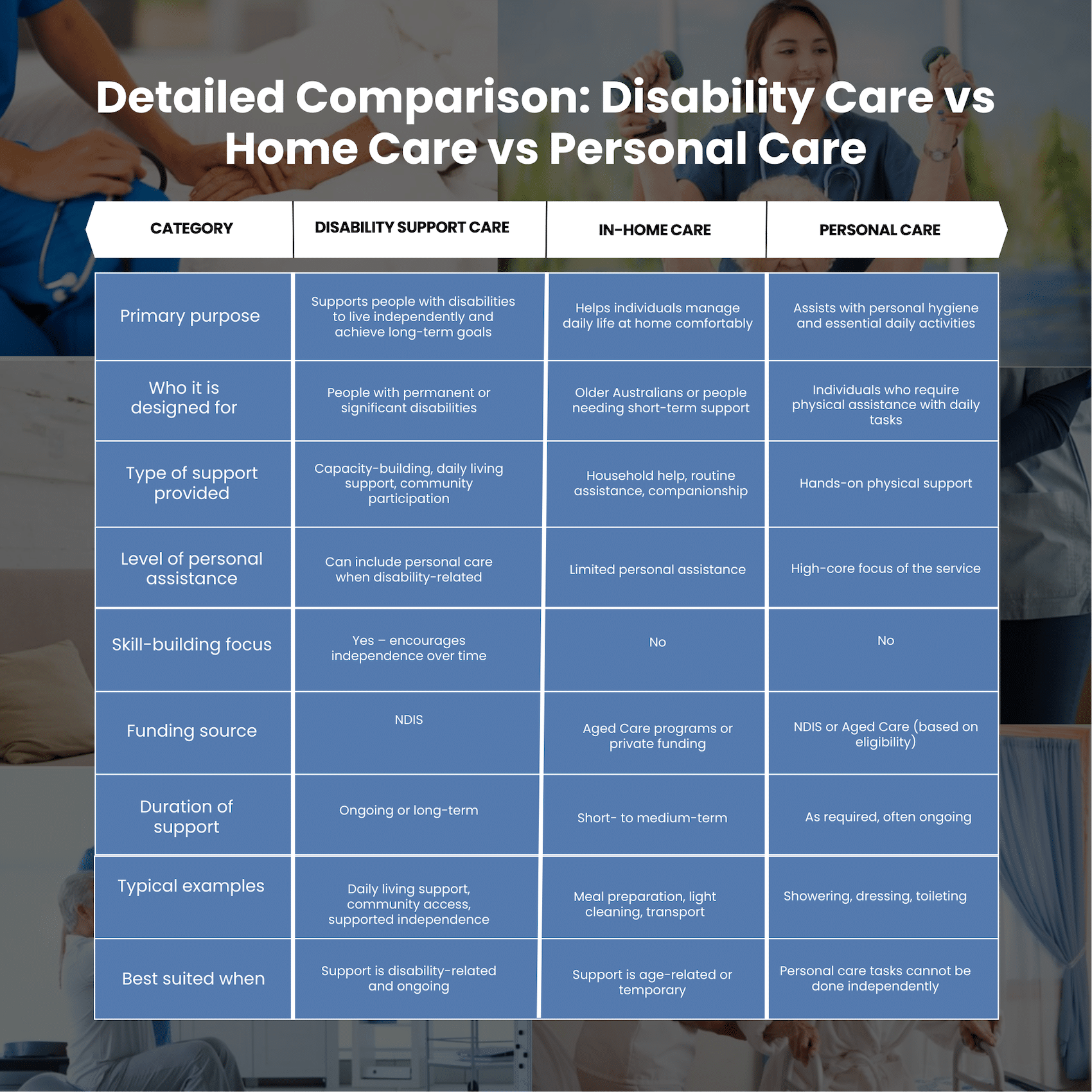
The table below explains how disability support, in-home care, and personal care differ in purpose, delivery, and real-life use. While there can be some overlap, each service is structured to address a specific type of care requirement.
Detailed Comparison: Disability Care vs Home Care vs Personal Care
What Each Type of Care Actually Means
While the comparison table shows the differences clearly, understanding what each type of care involves in practice can make the choice even easier. Below is a simple explanation of how disability support, in-home care, and personal care are typically delivered in Australia.
Disability Support Care
Disability support care is designed for people living with permanent or significant disabilities. The focus is on supporting independence, building daily living skills, and helping individuals participate in their community.
Common disability support services include:
- Assistance with daily living activities
- Support to access the community and social activities
- Skill-building for independent living
- Ongoing, goal-based support under an NDIS plan
Best suited for:
NDIS participants who require structured, long-term support related to their disability.
In-Home Care
In-home care provides practical support to help individuals manage everyday life within their own home. It is commonly used by older Australians or those who need short-term assistance due to illness, recovery, or reduced mobility.
Common in-home care services include:
- Help with household tasks such as cleaning and meal preparation
- General support with daily routines
- Companionship and transport assistance
Best suited for:
People who need help at home but do not require specialised disability support.
Personal Care
Personal care involves hands-on assistance with essential daily personal activities. It focuses on safety, comfort, and dignity and is often delivered as part of a broader care plan.
Common personal care services include:
- Showering and bathing assistance
- Dressing and grooming
- Toileting and mobility support
Best suited for:
Individuals who require physical assistance with personal tasks due to disability, ageing, or health-related needs.
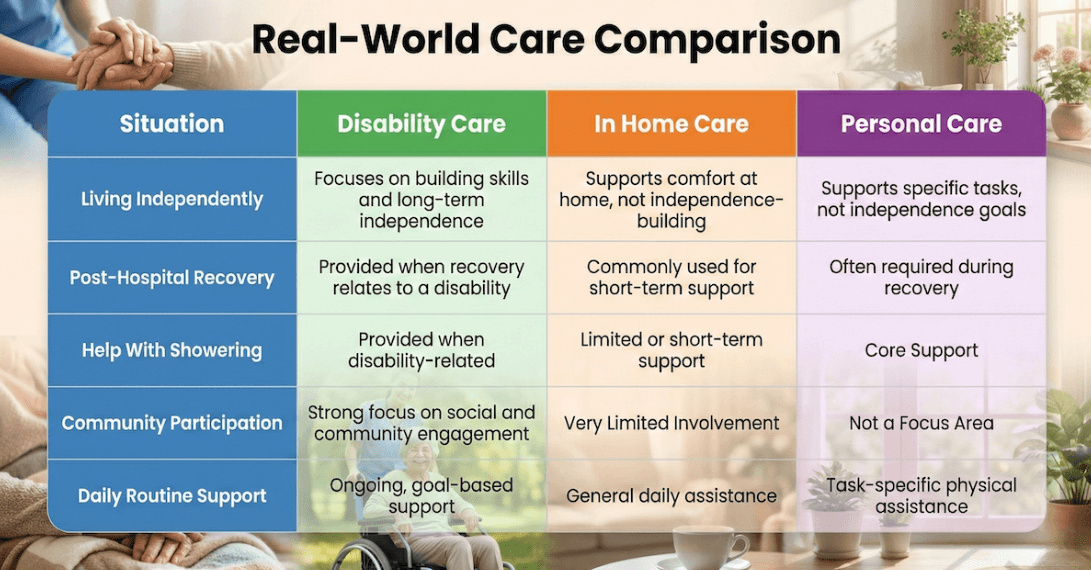
How Disability Care vs Home Care vs Personal Care Work in Real Life
Real-life situations show how such kinds of care actually work. The table below compares disability support, in-home care, and personal care across everyday scenarios people commonly face. Read further.
How to Choose the Right Care For You: Step by Step Guide

Choosing care becomes easier when the decision is broken into simple steps. Follow the guide below to identify the most suitable type of support based on your needs.
Step 1: Identify why support is needed
- If support is required due to a permanent or ongoing disability, disability support care is usually the right starting point.
- If support is mainly needed because of ageing, recovery, or temporary limitations, in-home care may be more appropriate.
- If the main challenge involves personal daily activities, personal care is often essential.
Step 2: Consider the level of assistance required
- Support that focuses on building independence, routines, or life skills aligns with disability support care.
- Help with household tasks, meal preparation, or general daily routines points towards in-home care.
- Hands-on physical assistance with showering, dressing, toileting, or mobility indicates a need for personal care.
Step 3: Think about how long support will be needed
- Long-term or ongoing support is best provided through disability support services.
- Short-term or flexible support is commonly delivered through in-home care.
- Daily or regular physical assistance is typically delivered through personal care, often alongside other supports.
Step 4: Check how the support is funded
- Support funded through an NDIS plan generally includes disability support care and may include personal care.
- Support accessed through aged care services or private funding commonly includes in-home care and personal care.
In many cases, care is not limited to one category. Services are often combined to ensure support fits real-life needs and provides practical, consistent assistance.
At A1 Disability Support Care, we help you understand which type of care applies to your situation and arrange the right support – whether that’s disability support, in-home care, personal care, or a combination of services.
Common Areas of Confusion When Choosing Care
Choosing between different cares is not always straightforward. Confusion around disability care vs home care often occurs because these services can overlap in daily support, even though they are designed for different needs.
Some of the most common areas where people feel unsure include:
- Understanding how personal care fits into other services
Personal care supports daily physical tasks, while disability support and in-home care provide broader assistance depending on the reason for support. - Knowing when disability support is required instead of in-home care
In-home care helps with daily living, but disability-related needs usually require structured support under the NDIS. - Uncertainty around funding and eligibility
Different care types are funded through different programs, which can affect what support is available. - Assuming one service will meet all needs
Many people benefit from a combination of supports rather than relying on a single care type.
Clarifying these areas helps individuals and families feel more confident when selecting care that aligns with their needs and circumstances.
Funding Differences: NDIS vs Other Care Options
Understanding how each type of care is funded is essential when comparing disability support, in-home care, and personal care. Funding often determines not only eligibility, but also the level and flexibility of support a person can access.
Below is a clear breakdown to help simplify this area.
When NDIS Funding Applies
Disability support is primarily funded through the National Disability Insurance Scheme (NDIS). This funding applies when:
- A person has a permanent and significant disability
- Support is required to improve independence, daily functioning, or community participation
- Services are considered reasonable and necessary under an approved NDIS plan
NDIS funding can cover a wide range of supports, including daily living assistance, personal care, community access, and capacity-building services.
When In-Home Care Is Funded
In-home care may be funded through:
- Aged Care programs (such as Home Care Packages)
- Private funding
- Short-term health-related support arrangements
This type of funding is generally used when support is required due to age, illness, recovery, or reduced mobility, rather than disability-related needs.
How Personal Care Is Funded
Personal care funding depends on the reason support is required:
- NDIS funding when personal care is linked to a disability
- Aged Care funding when support is age-related
- Private funding for short-term or flexible assistance
Personal care often forms part of a broader support plan rather than being a standalone service.
A1 Disability Support Care works with NDIS participants and individuals accessing private or aged care support, helping navigate funding options while ensuring care remains flexible and personalised.
Why Funding Matters When Choosing Care
Funding affects:
- The type of services available
- The number of support hours approved
- Flexibility in choosing providers
Understanding these differences helps avoid delays and ensures the right care is put in place from the beginning.
Quick Summary of Which Care Meets Which Need?
This snapshot brings everything together, making it easier to see which type of care aligns best with specific needs. It is designed for quick decision-making, especially for readers who want a clear answer without revisiting every section.
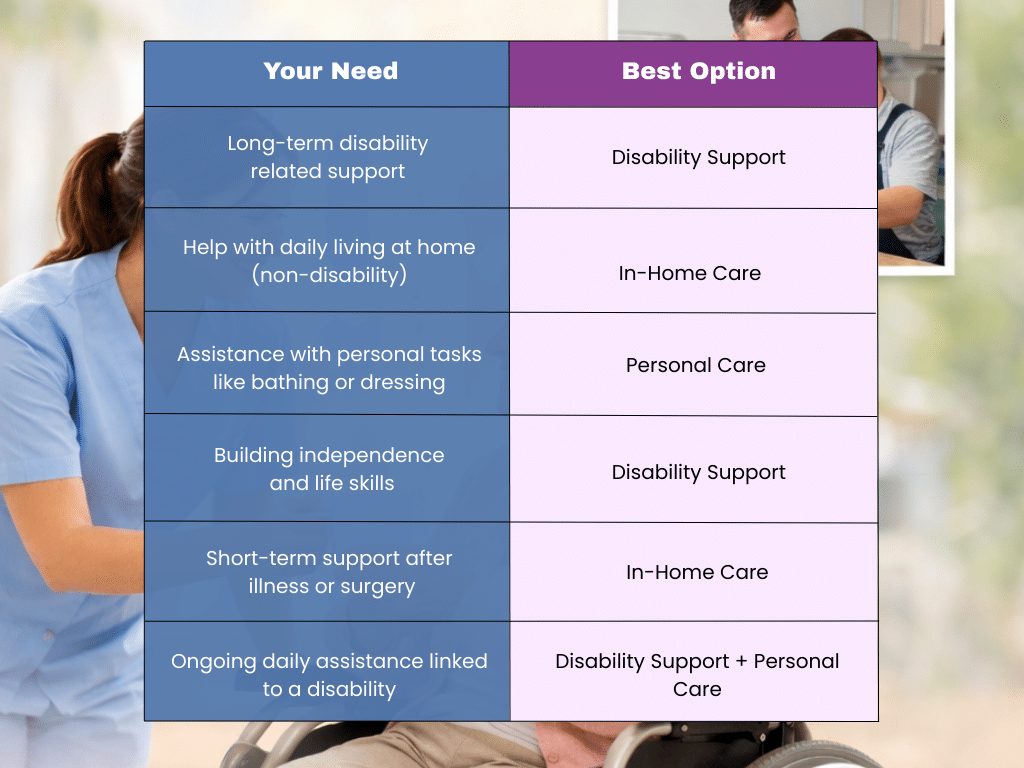
This table reinforces the key differences while highlighting that some people may benefit from a combination of care types rather than a single solution.
NDIS participants across Brisbane often ask us which support option best fits their daily needs.
Conclusion
Understanding the difference between disability support vs in-home care, and personal care is essential when making care decisions. Each service serves a different purpose, and choosing the right one can make a meaningful difference to daily life, independence, and wellbeing.
At A1 Disability Support Care, we provide all three services – disability support, in-home care, and personal care – so support can be tailored around what you actually need. Whether you require long-term disability support, help at home, or assistance with daily personal tasks, our focus is on matching the right care to the right situation.
If you are unsure which type of care is right for you or a loved one, speaking with a provider who understands these differences can help you move forward with confidence.
A1 Disability Support Care is here to guide you through your options and provide care that supports your goals, independence, and quality of life.
To learn more about disability support, in-home care, or personal care, get in touch with A1 Disability Support Care to explore your options.
Frequently Asked Question
Q1: What is the difference between Disability Care vs Home Care vs Personal Care?
Ans: In the comparison of Disability Care vs Home Care vs Personal Care, disability care focuses on long-term support for people living with disabilities. In-home care services Australia generally assist individuals who need help with daily activities due to ageing, illness, or recovery. Personal care services involve hands-on assistance with hygiene, grooming, dressing, and mobility.
Q2: What is disability support care?
Ans: Disability support care refers to services that help individuals with disabilities manage daily living activities, improve independence, and participate in their communities. These NDIS disability support services may include mobility assistance, skill development, personal care, and community participation support.
Q3: Is personal care included in disability support?
Ans: Yes. In the comparison of personal care vs home care services, personal care is often a key component of NDIS disability support services. It includes assistance with bathing, dressing, hygiene, and other essential daily tasks when support is required due to disability.
Q4: Disability care vs home care – which services are funded by the NDIS?
Ans: When comparing disability support vs in-home care, disability support services may be funded by the NDIS if the participant meets the eligibility criteria. Standard in-home care services Australia that are related to ageing or general household assistance are usually funded through other programs or private arrangements.
Q5: When are in-home care services the better option?
Ans: In-home care services Australia are often the better option when someone needs support with household tasks, meal preparation, or short-term assistance during recovery. These services may not always fall under NDIS disability support services unless the need is related to a disability.
Q6: Can someone receive disability support, home care, and personal care together?
Ans: Yes. Many people combine disability support vs in-home care and personal care vs home care services depending on their needs. A personalised plan may include disability support, household help, and personal care to ensure comprehensive support at home.
Q7: Does A1 Disability Support Care provide all these services?
Ans: Yes. A1 Disability Support Care offers a full range of NDIS disability support services, including disability care, in-home care services Australia, and personal care support. Services are tailored to each participant’s needs to improve independence, comfort, and quality of life.