

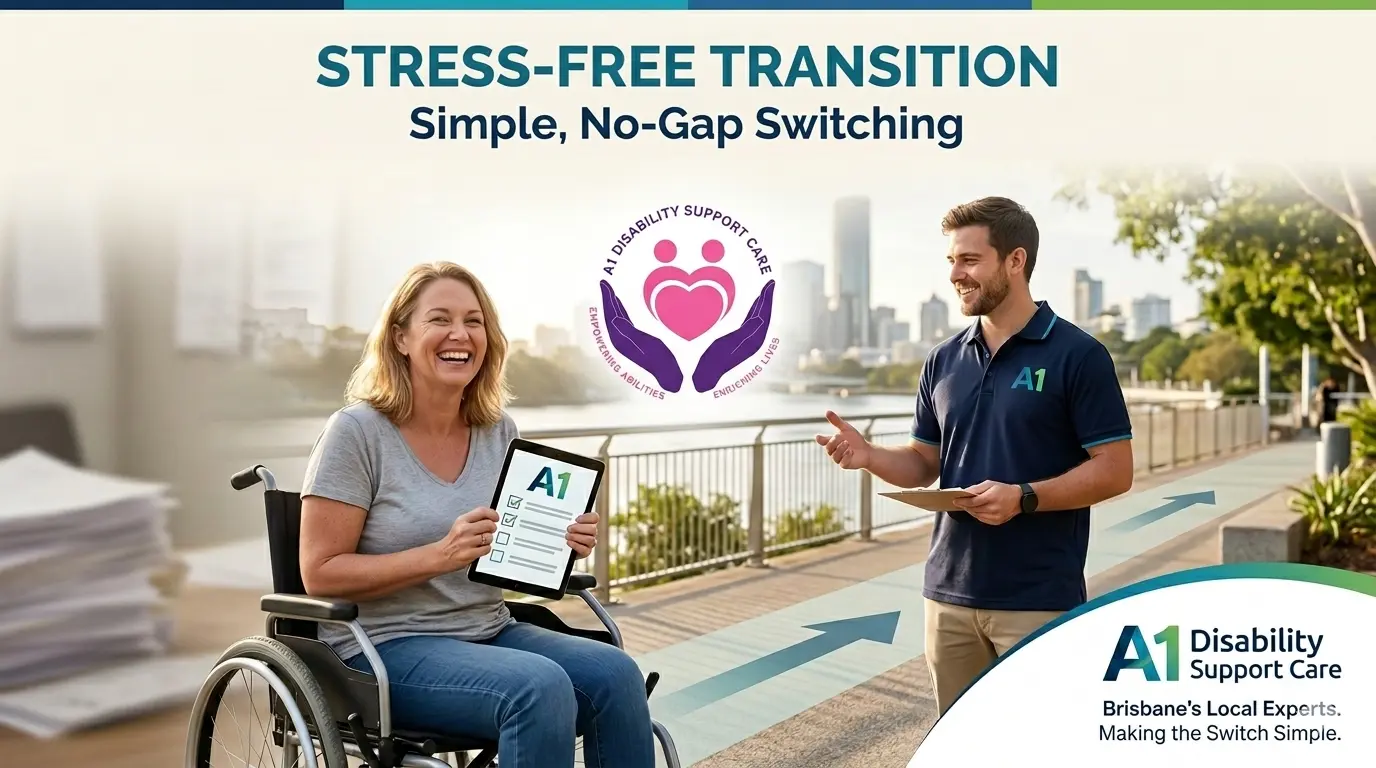
Finding a disability support provider in the current market is relatively straightforward; however, finding the right partner for your long-term goals is a process that requires diligence, patience, and a clear understanding of your rights. For many participants in Brisbane and South East Queensland, the National Disability Insurance Scheme (NDIS) represents a gateway to independence.
Yet, the administrative hurdles, complex service agreements, and the very real exhaustion of dealing with bad providers. It can often feel like a barrier to the freedom the scheme is designed to provide.
At A1 Disability Support Care, we believe that transparency is the foundation of our relationship with you. We do not just provide services; we provide clarity. This comprehensive guide is designed to explain how the NDIS all works, helping you audit your current level of care and providing a detailed blueprint for transitioning to a higher standard of support without losing a single hour of essential service.
We will explore exactly what it takes to switch NDIS disability providers smoothly.
Why Quality Matters More Than Ever
As the NDIS landscape evolves, the gap between standard providers and exceptional partners has widened significantly. Quality support is no longer just about filling a roster or making sure someone shows up at your door. It is fundamentally about how that support impacts your daily life and your future.
When you evaluate your current care, you need to look at three core pillars:
- Capacity Building: Does your current provider actively help you do more for yourself, fostering genuine independence over time?
- Worker Consistency: Are you exhausted from explaining your routine to a new, unfamiliar face every week?
- Local Accountability: Is your provider truly based in your community, or is your care being managed by a distant call center in another state?
What This Guide Covers
To help you navigate your choices and reclaim your NDIS choice and control, we have structured this comprehensive guide into several critical areas. We will look at the signs that it is time to move on, the technical logistics of changing NDIS providers, the financial realities of plan management, and how our localized, participant-first approach in Brisbane ensures that your NDIS plan is maximized for your specific lifestyle.
1. Defining Quality in the NDIS Landscape: Beyond the Basics
When searching for a new provider, you will encounter dozens of companies claiming to be the best. However, true quality in the disability sector is not a marketing slogan; it is a measurable set of benchmarks regulated under the NDIS Practice Standards. High-quality care is designed to empower you, not to make you dependent on the system or the provider.
What High-Quality Support Looks Like in Practice
Active Capacity Building
High-quality support follows a strict person-centered approach. This means your support worker should not just do things for you automatically. Instead, they should work alongside you. Whether it is cooking a meal, doing the laundry, or budgeting for weekly groceries, the goal is to teach new skills and build your confidence so you can eventually perform these tasks independently or with minimal assistance.
Alignment with Individual Values and Beliefs
Your care should be as unique as you are. Whether you have specific cultural traditions, religious practices, or personal lifestyle choices, a quality provider must actively incorporate these nuances into your Service Agreement and your daily care plan. Respecting your background is a mandatory part of good service delivery.
Upholding Privacy and Dignity
You have a fundamental right to feel completely safe and respected in your own home. A standard provider implements strict data protection and personal privacy protocols. This ensures that your medical history and personal life remain confidential and that your dignity is prioritized during every single interaction, especially during personal care routines.
Ethical Conflict of Interest Management
A reputable provider prioritizes your needs over their profit margins. They should never pressure you to use their affiliated therapists, their preferred plan managers, or partner agencies if it does not suit you. Your provider should offer unbiased recommendations that serve your best interests, upholding your right to true choice and control at all times.
Proactive Feedback Systems
Quality is maintained through active listening. A top-tier provider has clear, accessible channels for you to provide feedback or raise concerns without any fear of retribution. If something is not working, you should feel comfortable saying so, knowing that your care plan will be adjusted to meet your standards.
2. Recognizing the Red Flags: When Should You Consider Switching Providers?
Staying with a provider out of habit, or simply because you fear the administrative paperwork mountain, can significantly stall your personal progress. Your NDIS funding is a vital investment in your future. If your current provider is not delivering, you are the one who pays the price in lost opportunities and stagnant growth.
At A1 Disability Support Care, we regularly help participants identify when their current arrangement has shifted from supportive to stagnant. If you recognize any of the following red flags, it is time to seriously reassess your current partnership.
Chronic Staff Turnover
Consistency is the absolute foundation of safety and trust in disability care. If you are seeing a different, unfamiliar face every week, it is impossible to build a routine or a meaningful connection. You spend all your time explaining your needs rather than working on your goals. A provider that cannot retain their staff often fails to provide the stable environment necessary for your personal growth.
The Communication Black Hole
In the disability support sector, timely communication can be a matter of immediate safety. It should never take three business days to get a return call from your Support Coordinator or your roster manager. If you consistently feel ignored or if you feel like you are just another number on a spreadsheet, your provider has lost sight of the person-centered mission.
Stagnant Goal Progress
Your NDIS plan is reviewed annually for a very specific reason: to track your personal growth. If you find yourself sitting at your plan review meeting with no movement toward your primary goals, something is wrong. Whether your goal was gaining employment, learning a life skill, or increasing your community access, a lack of progress means your provider likely is not challenging you or providing the right capacity-building opportunities.
Inflexible Roster Management
The NDIS is entirely built on your right to choose. If your provider dictates when they will arrive, rather than working around your lifestyle and your personal preferences, they are failing the choice and control test. You should always be the architect of your roster. You are not the recipient of whatever shift is left over at the end of the week.
Lack of Specialized Expertise
As your life changes, your needs change, and your provider must adapt accordingly. If your care requirements have become more complex—perhaps requiring complex bowel care, hoist transfers, or severe behavioral support—and your current provider is just guessing rather than bringing in specialized training, your physical safety may be at risk.
Recognizing these signs is the very first step toward reclaiming the quality of life you deserve. Switching is not just about changing a company name on a contract; it is about choosing a dedicated team that is as invested in your daily goals as you are.
3. The Technical Blueprint: How to Switch Providers Without a Gap in Care
This is often the most critical stage for anyone considering a disability care transition. We understand that the transition period is when participants and their families feel the most vulnerable. The fear of being left without essential daily support is the number one reason people stay with subpar providers for years longer than they should.
To eliminate this massive risk, A1 Disability Support Care utilizes a rigorous transition protocol. This protocol is specifically designed to keep your care continuous, safe, and entirely stress-free.
Phase A: The Compliance Audit
Before making any moves, we help you understand your current legal and financial standing to avoid any nasty surprises or billing errors.
- The Termination Clause Review: We help you locate the termination of agreement clause in your current contract. Understanding the NDIS service agreement notice period is critical. While the NDIS generally suggests a standard 14-day notice, some providers write 28 days or even 30 days into their fine print. Knowing this exact date is vital for a clean, undisputed break.
- NDIS Myplace Portal Check: It is essential to verify how much funding is currently locked in Service Bookings with your outgoing provider. A new service booking cannot be activated by a new provider until the old one is finalized, reduced, or canceled entirely. We guide you through checking this balance to ensure your funding is released and ready for the move.
Phase B: The Strategy and the Warm Handover
We do not believe in cold starts. At A1, we prioritize your emotional comfort alongside your physical care needs.
- The Shadow Shift Strategy: To remove the fear of the unknown, we highly recommend a shadow shift or an informal meet-and-greet while your old provider is still technically active. This allows you to build rapport with your new A1 support worker in a low-pressure environment. It ensures that a familiar, friendly face arrives on day one of your new agreement.
Phase C: Execution and Documentation
A seamless switch requires a clear digital paper trail to protect your rights and your funding as an NDIS participant.
- The Formal Exit Letter: You do not have to worry about what to say to your old provider. We provide you with a professional, legally sound notice template to send via email. This creates an undeniable digital record of your intent to switch and clearly states your final date of service.
- The A1 Service Agreement: Your new agreement with us is built on absolute transparency from day one. It will explicitly list current NDIS pricing rates with absolutely no hidden markups. It will include detailed travel and transport cost breakdowns, and specific, measurable goals tailored directly to your current NDIS plan.
- The Schedule of Supports: Never sign an agreement that does not include a clear, written timetable of exactly when and how your support will be delivered week to week.
Our primary goal is a zero-gap transition. By perfectly aligning your exit date with our start date, we ensure your daily routine remains undisturbed while your quality of care significantly improves overnight.
4. How Your Funding Management Type Affects the Switch
When you decide to switch NDIS disability providers, the exact administrative steps you take will depend heavily on how your NDIS funding is currently managed. The NDIS offers three main ways to manage your funds, and understanding your specific category will make the transition much smoother.
Self-Managed Participants
If you self-manage your NDIS funds, you have the highest level of control, but also the most administrative responsibility. When switching providers, you do not need to wait for a third party to approve the change. You simply notify your current provider according to the NDIS service agreement notice period, pay their final invoices directly through the portal, and sign a new agreement with A1. You are fully in charge of managing the start and end dates.
Plan-Managed Participants
If you use a Plan Manager, they act as your financial intermediary. They pay the bills on your behalf. When changing NDIS providers, you must inform your Plan Manager immediately in writing. You will tell them the exact date your old provider is finishing and the date A1 is starting. This ensures your Plan Manager stops paying invoices from the old company and allocates the correct funds for our upcoming services. A good Plan Manager will handle the background accounting seamlessly.
NDIA-Managed (Agency Managed) Participants
If your funds are managed directly by the National Disability Insurance Agency, the process relies heavily on the NDIS myplace portal. Your old provider must physically go into the portal and end their existing service booking. Until they release those funds, we cannot create a new service booking to claim for your care. If an old provider is dragging their feet, you may need to call the NDIS contact center to have the booking manually removed so you can transition to us without delay.
5. In-Depth Service Breakdown: Defining the A1 Standard
At A1 Disability Support Care, we actively challenge the traditional provider mindset. We do not just deliver hours of care; we architect specialized pathways to independence. Every single service we offer is designed to reduce your reliance on paid support over time by building your personal confidence and your functional skills.
Specialized In-Home Support: Transforming Your Living Space
Our in-home care goes far beyond basic domestic assistance like vacuuming and washing dishes. We focus on turning your home into a hub of personal autonomy.
- Assistive Technology Integration: Technology can be an absolute game-changer for independent living. Our trained team helps you integrate and master practical tools. This ranges from setting up smart home voice commands for lights and doors, to sourcing specialized cooking utensils, to utilizing text-to-speech communication apps. We make navigating your daily life easier and far safer.
- Active Skill Transfer: Instead of simply doing household tasks for you, we prioritize teaching. Whether it is mastering safe meal prep techniques, managing your own laundry cycles, or organizing a complex daily medication schedule, we use Step-by-step coaching. We help you eventually perform these tasks with minimal to no supervision.
Community and Social Participation: Breaking the Isolation Barrier
The NDIS specifically allocates funding for community engagement because social connection is a fundamental human right, not a luxury. We help you utilize this specific funding to build a robust, enjoyable life outside the four walls of your home.
- Vocational and Educational Support: Whether you are heading to a new job, starting a volunteer placement, or attending classes at TAFE, we provide the logistics and the discrete on-site support to ensure you succeed in professional and educational environments.
- Confidence in Transport Training: We do not just drive you from point A to point B in a modified van. We offer dedicated, practical training on Brisbane’s public transport network. We help you master reading timetables, managing your Go-Card usage, and practicing route planning so you can eventually travel solo with complete confidence.
- Integrated Health and Wellness: We act as your reliable support bridge to allied health professionals. We accompany you to specialized exercise physiology appointments, weekly hydrotherapy, or gym sessions to ensure you are getting the absolute most out of your physical therapy routines.
Respite and Short-Term Accommodation: The Growth Retreat
We view Respite and Short-Term Accommodation (STA) not just as a temporary stay or a babysitting service, but as a strategic growth period for the participant and a vital, necessary recharge for the primary carer.
- Socialization in a Holiday Setting: Our selected STA options allow you to meet new people and engage in structured group activities in a relaxed, resort-style environment. This fosters natural social skills that are often much harder to build in a quiet home environment.
- The Independent Living Trial: STA serves as a safe, 24/7 supported environment to practice living away from your family. It is an essential, practical stepping stone for participants who have the long-term goal of eventually moving into Supported Independent Living (SIL) or securing their own private rental property.
We measure our ultimate success by your progress. If you find yourself needing our daily services less because you can do more for yourself, we know we have successfully achieved the A1 Standard.
6. Navigating the Financial Side: Transparency in NDIS Pricing
One of the primary reasons online content about the NDIS often feels thin or unhelpful is that it avoids discussing the most important topic: the money. At A1 Disability Support Care, we firmly believe that financial literacy is the key to maximizing your NDIS plan. To exercise true choice and control, you must understand exactly how your budget is being allocated, billed, and spent.
The NDIS budget is generally divided into three distinct buckets. Understanding the flexibility and the strict limitations of these categories is essential for your long-term planning.
Understanding Your NDIS Budget Categories
| Support Category | Funding Nature | Strategic Usage and What to Look For |
| Core Supports | Highly Flexible | This is your daily life budget. It is the most flexible category by far. It allows you to move funds between personal care, social activities, and everyday consumables (like continence aids) as your needs change throughout the week or month. |
| Capacity Building | Goal-Specific | This funding is fixed to specific outcomes. It is used exclusively for therapies (Occupational Therapy, Physiotherapy, Speech Pathology), employment training, and plan management fees. Unlike Core, these funds cannot be swapped between categories. They must be used to build the specific skill listed in your plan. |
| Capital Support | Specialized & Fixed | This is strictly reserved for big-ticket items. It includes high-cost Assistive Technology, structural home modifications, or specialized vehicles. These funds require expert quotes and explicit NDIA approval before any purchase can be made. |
The A1 Commitment to Price Integrity
The NDIS is a taxpayer-funded scheme, and every single dollar must be used effectively to ensure your allocated support lasts the full duration of your plan year. Running out of funds early is highly stressful and entirely preventable.
- Strict Price Cap Adherence: We adhere strictly to the NDIS Pricing Arrangements and Price Limits. We do not apply any hidden markups, premium surcharges, or unexplained administration fees.
- Protection Against Provider Inflation: Some less reputable providers may attempt to charge higher hourly rates for the same service once they see you have been granted a larger budget. We maintain flat, transparent, standard pricing regardless of your total plan value.
- Detailed Invoicing: Every single invoice you or your Plan Manager receives from A1 is thoroughly itemized. You will see exactly which NDIS line item code was used, the exact duration of the shift, and the specific hourly rate applied. This allows for easy, stress-free auditing of your funds.
Always ask a potential provider for their schedule of rates in writing before signing any Service Agreement. If they are hesitant to provide clear pricing or if they give vague answers about their billing practices, consider it a massive red flag.
7. Managing the Psychological Impact of Changing Providers
While the administrative logistics of changing NDIS providers are important, the emotional and psychological aspects are often overlooked. For many participants, support workers are not just employees; they become trusted fixtures in your daily routine. Allowing someone new into your home to assist with highly personal tasks requires immense vulnerability.
Acknowledging the Stress of Transition
It is completely normal to feel anxious about ending a long-term service agreement. You might worry about hurting your current support worker’s feelings, or you might fear that a new company won’t understand your specific triggers or your communication style. At A1, we validate these concerns. We know that trust cannot be demanded; it must be earned through consistent, respectful actions.
Building Trust Slowly
We do not rush the transition process. If you need multiple meet-and-greets before officially starting services, we accommodate that. If you want a family member present for the first few weeks of personal care, that is entirely welcome. Our onboarding process involves comprehensive intake interviews where we document not just your medical needs, but your likes, dislikes, sensory preferences, and conversational boundaries. We ensure our staff read this profile thoroughly before they ever knock on your door.
By prioritizing your emotional safety and pacing the transition to suit your comfort level, we mitigate the stress usually associated with a disability care transition.
8. Frequently Asked Questions: Expert Insights for Participants
In the final stages of choosing a new provider, specific, highly logistical concerns often stand in the way of making a confident decision. This section addresses the most pressing questions we receive from participants across Brisbane, providing the absolute clarity you need to move forward.
What if I have an emergency or my new support worker does not show up?
This is understandably one of the most common anxieties for those transitioning to a new provider. At A1 Disability Support Care, we have eliminated this risk through a highly proactive emergency management protocol. We maintain a dedicated emergency roster 24/7. If your regular worker is unwell, stuck in traffic, or delayed, our software system alerts management immediately. We activate a next-in-line backup protocol to ensure a qualified, fully briefed staff member is dispatched to your location. You are never left without essential care, medication assistance, or safety.
Can I switch providers even if I am right in the middle of my NDIS plan year?
Absolutely. One of the most persistent and damaging NDIS myths is that you are legally locked into a provider until your annual plan review meeting. You have the total freedom of movement. You have the fundamental right to switch at any time. You do not need to wait for a plan meeting, and you do not need to ask for permission from the NDIA. You simply fulfill the notice period stated in your current agreement, and then your funding is free to be redirected.
Can my old provider charge me an exit fee for leaving?
Under NDIS rules, providers generally cannot charge arbitrary cancellation or exit fees just because you choose to leave. They can only bill for the services they actually delivered up until the end of your notice period. If a provider tries to withhold funds or bill you a penalty for terminating the contract early, this is a breach of NDIS guidelines and should be reported.
Do I need to personally inform my NDIA Planner that I am switching?
While it is not a legal requirement to call the NDIA and tell them, clear communication with your immediate team ensures a smoother administrative transition. If you have a Support Coordinator, they should be your very first point of contact. They play a vital role in finalizing your current service bookings and helping us activate new ones.
What happens to my personal data, notes, and medical history during a switch?
Your history and your personal data belong entirely to you, not the provider. When you make the move to A1 Disability Support Care, we actively guide you through the process of requesting your participant profile, behavior support plans, and daily medical logs from your outgoing provider. This ensures we understand your medication schedules, physical triggers, and daily preferences from the very first shift. We do not do trial and error with your healthcare.
What if my needs are highly complex, involving hoists, PEG feeding, or severe mobility issues?
We conduct a thorough clinical handover for high-intensity needs. We will not take on your care unless we can guarantee we have the specifically trained staff to manage your exact medical requirements safely. If you require manual handling, our registered nurses will ensure our support workers are competency-assessed on your specific equipment before they commence shifts.
9. The Power of Proximity: Why Local Brisbane Expertise is a Must-Have
In an era of massive, national mega-providers and automated gig-economy apps, the massive value of local expertise is often completely overlooked. However, for NDIS participants, the physical distance between you and your provider’s management team can directly impact the daily quality of your care. While a national agency might offer a polished website and a slick digital interface, they almost always lack the on-the-ground knowledge that defines a truly integrated life.
At A1 Disability Support Care, we are built by and entirely for the Brisbane community. Here is exactly why local roots matter for your care.
Hyper-Local Recruitment and Staffing
We do not just hire staff for their base qualifications; we hire them for their community connections. By employing support workers who actually live in your specific neighborhoods—from the bustling Brisbane CBD and Logan to the quieter suburbs of Ipswich and Moreton Bay—we ensure your support team fundamentally understands the local geography. They know the local commute times, the traffic patterns, and the community culture. This leads directly to better punctuality, fewer late cancellations, and much more consistent staffing.
Deep-Rooted Local Knowledge
True community participation requires knowing exactly where the physical and social barriers are. Our team has vetted the local region extensively. We know exactly which gyms in the South Bank area have the most accessible, hoist-friendly change rooms. We know which popular cafes in Paddington are truly wheelchair-friendly (not just claiming to be). We know which quiet, shaded parks in Chermside are best for participants dealing with sensory processing sensitivities. We do not rely on Google Maps to guess; we rely on local experience to know.
Rapid, Human-Led Response
When your daily schedule changes rapidly, or a medical emergency arises in your home, you do not want to explain your complex situation to a stressed call center operator sitting in another state who has never set foot in Queensland. Our local management offices are just minutes away. This physical proximity allows us to react with a level of speed, empathy, and personal accountability that massive national corporations simply cannot match.
A Neighborly Accountability
Because we operate in the same streets where our participants live, our professional reputation is on the line every single day. We are not a faceless corporate brand; we are your neighbors. This creates a powerful, natural drive to provide a substantially higher standard of care—the A1 standard—because we are deeply and personally invested in the overall well-being of the Brisbane disability community. Choosing A1 means choosing a team that knows your streets, your local shopping centers, and your community hubs just as well as you do. We are not just parachuting in to provide a service in Brisbane; we are an active part of Brisbane.
10. Document Checklist for a Smooth Transition
To ensure nothing is missed when you decide to change NDIS providers, gather the following documents before you initiate the switch. Having these ready will drastically speed up the intake process with A1:
- Your Current NDIS Plan: The full document, showing your current goals and budget breakdowns.
- Your Current Service Agreement: So we can review the exact terms of your notice period.
- Allied Health Reports: Any recent reports from your Occupational Therapist, Speech Pathologist, or Physiotherapist that detail your physical requirements or required home modifications.
- Behavior Support Plan (if applicable): Crucial for ensuring our staff is immediately trained on your specific support strategies.
- Medication Charts: A current list of all medications, dosages, and administration times.
- Emergency Contacts: Up-to-date details for your next of kin, your GP, and your Support Coordinator.
Conclusion: Empower Your Future with A1 Disability Support Care
The National Disability Insurance Scheme was designed from the ground up to give you a significantly better life, not to bury you in endless paperwork, stress, and provider negotiations. By choosing a provider that strictly prioritizes open communication, deep local knowledge, and total technical transparency, you are taking the final, crucial step toward genuine independence and peace of mind.
Do not settle for “okay” care or a stagnant routine when you can experience the A1 level of support. You deserve a team that actively advocates for you, respects your home, and pushes you toward your highest potential.
Take action today to secure your future. Let us handle the frustrating paperwork, the portal bookings, and the logistics of switching so you can get back to focusing on living your life.
Contact Us Today to Start Your Transition
A1 Disability Support Care
- Office Address: Suite 13/3 Clunies Ross Court, Eight Mile Plains, QLD 4113, Australia
- Email: info@a1disabilitysupportcare.com.au
- Phone: 07 3473 1700
- Opening Hours: Monday – Sunday 9 am–5 pm
Your journey to better choice and control starts with a single conversation. Reach out to our local Brisbane intake team today.